
Ethernet cables may look almost identical from the outside, but their supported frequency, crosstalk performance, transmission distance and installation requirements can differ substantially.
For a short connection between a computer and a home router, almost any correctly manufactured Cat5e or higher cable may provide Gigabit Ethernet. For a new office, Wi-Fi access point, surveillance system or 10 Gigabit network, however, choosing the wrong cable can create performance limitations that are expensive to correct later.
The best Ethernet cable is therefore not always the cable with the highest category number. The correct choice depends on:
This guide compares Cat5e, Cat6, Cat6a and Cat7 cables and explains which category is most appropriate for different applications.
For most users:

An Ethernet cable category defines a set of electrical-performance requirements for balanced twisted-pair cabling.
These requirements may include:
A higher category generally provides more performance headroom, but the category printed on the cable does not independently guarantee a particular network speed.
The complete channel includes:
The channel is normally limited by its lowest-performing component.
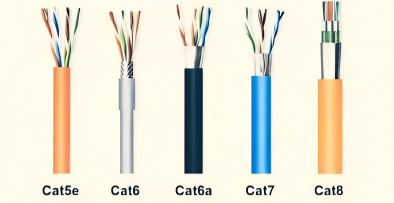
| Feature | Cat5e | Cat6 | Cat6a | Cat7 / Class F |
|---|---|---|---|---|
| Nominal frequency | 100 MHz | 250 MHz | 500 MHz | 600 MHz |
| Common connector | RJ45 | RJ45 | RJ45 | GG45 or TERA |
| Common 1G reach | Up to 100 m | Up to 100 m | Up to 100 m | Up to 100 m |
| 2.5G/5G support | Possible up to 100 m on qualified cabling | Up to 100 m | Up to 100 m | Supported within compatible systems |
| 10G support | Not recommended as a general 10G solution | Approximately 37 m; possibly up to 55 m depending on alien crosstalk | Up to 100 m | Up to 100 m |
| Typical shielding | Usually U/UTP; shielded versions exist | U/UTP or shielded | U/UTP or shielded | Normally fully shielded |
| Standards position | TIA and ISO/IEC | TIA and ISO/IEC | TIA and ISO/IEC | ISO/IEC; not recognized by TIA |
| Best use | Existing Gigabit networks | Homes and small businesses | New enterprise and 10G installations | Specialized shielded Class F systems |
IEEE completed the 2.5GBASE-T and 5GBASE-T standard specifically to support higher speeds over parts of the installed Cat5e and Cat6 cabling base. However, existing links may require qualification because cable quality, bundling and noise conditions affect actual performance.
Cat5e, or Category 5 enhanced, is an improved version of the original Category 5 cabling specification.
It is rated to 100 MHz and is widely used for:
A standards-compliant Cat5e channel can support Gigabit Ethernet over a total channel length of up to 100 m.
It can in many cases.
IEEE 802.3bz introduced 2.5GBASE-T and 5GBASE-T partly to provide higher speeds over existing Cat5e and Cat6 infrastructure. However, not every installed Cat5e cable plant will perform equally well, especially in large bundles or electrically noisy environments. Qualification testing may be necessary before deployment.
Very short Cat5e patch cables may sometimes establish a 10G link under favorable conditions, but Cat5e is not the appropriate standards-based choice for a planned 10GBASE-T installation.
For reliable 10G over structured cabling, Cat6a is the safer design choice.
Cat5e remains reasonable when:
For new permanent commercial cabling, Cat6 or Cat6a generally provides more upgrade headroom.
Cat6 is rated to 250 MHz and provides improved crosstalk and return-loss performance compared with Cat5e.
It is commonly used for:
Cat6 can support Gigabit Ethernet over a 100 m channel.
Yes, but not necessarily over the full 100 m.
Guidance for existing Cat6 installations indicates that 10GBASE-T should generally operate over channel lengths up to approximately 37 m. Between 37 and 55 m, successful operation depends on the alien-crosstalk environment, cable design, bundling and installation quality. Testing is the only reliable way to confirm an existing channel.
This is why “Cat6 supports 10G up to 55 m” should not be treated as an unconditional guarantee.
No.
Many Cat6 cables use a cross-shaped separator to maintain pair spacing and reduce crosstalk. Other compliant designs achieve the required electrical performance without a conventional cross filler.
Both filler and fillerless Cat6 constructions can meet applicable performance requirements when correctly designed and installed.
Cat6 is a practical option when:
Cat6a means Category 6 augmented.
It is rated to 500 MHz and was developed to support 10GBASE-T over a complete 100 m channel. Category 6A/Class EA remains the standard copper choice for new horizontal cabling that requires predictable 10G performance.
Cat6a is commonly selected for:
No.
Cat6a is available in multiple constructions, including:
Both shielded and unshielded Cat6a systems are commercially available and can meet Category 6A performance requirements.
Shielded cable may be beneficial in environments with:
However, shielded systems require compatible shielded connectors and correct bonding and grounding practices.
The category name alone does not determine power efficiency.
Cable heating in PoE applications depends on:
Many Cat6a products use larger conductors and may offer better thermal performance, but this is a product-design advantage rather than a universal rule for every Cat6a cable.
Cat6a is normally the strongest general-purpose choice when:
Cat7 is a fully shielded cabling category defined within the ISO/IEC system as Category 7/Class F.
It is specified to 600 MHz and was developed to support 10 Gigabit Ethernet over a 100 m channel while providing strong resistance to internal and external crosstalk.
A genuine Cat7 system generally uses:
No.
Category 7/Class F is recognized by ISO/IEC, but it was not adopted as a TIA cabling category in North America. TIA moved from Category 6A toward Category 8 for higher-performance twisted-pair applications.
A complete standards-based Cat7 channel normally uses GG45 or TERA interfaces.
GG45 was designed with a degree of backward compatibility for conventional RJ45 plugs, while TERA uses a different interface and may require hybrid patch cords for connection to RJ45 equipment.
A cable labeled “Cat7” but terminated with ordinary Cat6a RJ45 connectors should not automatically be treated as a complete Cat7/Class F channel. The system performance is limited by the installed connectors and other channel components.
Not as a standardized 100 m Ethernet channel.
Cat7 was primarily designed for 10G operation at up to 100 m. Standardized 25GBASE-T and 40GBASE-T copper applications use Category 8/Class I or Class II cabling and are generally limited to a 30 m channel.
There is no general Ethernet standard that turns a Cat7 cable into a 100G copper link merely because its measured frequency exceeds that of Cat6a.
Cat7 may be considered when:
For ordinary home and enterprise networks using RJ45 equipment, Cat6a is usually simpler and more interoperable.
Cat8 is the category designed for standardized high-speed twisted-pair applications beyond 10GBASE-T.
It supports a frequency range up to 2,000 MHz and is intended for 25GBASE-T and 40GBASE-T over channels of up to approximately 30 m.
Typical applications include:
Cat8 is not normally necessary for home networks or general office horizontal cabling. Its shorter distance and higher installation cost make it a specialized data center solution.
Cat7 has a higher nominal frequency and stronger shielding, but that does not make it the better choice for every network.
For most new RJ45-based enterprise installations, Cat6a provides the better balance of performance, compatibility and cost.
The category and shielding construction are separate specifications.
Common abbreviations include:
Shielded cable may reduce electromagnetic interference, but it is not automatically superior in every installation.
A properly installed U/UTP Cat6a system can support 10GBASE-T. A poorly grounded shielded system may add cost and complexity without delivering its intended benefit. Current commercial Cat6a systems are available in both U/UTP and shielded designs.
Not directly.
Frequency rating describes the tested electrical bandwidth of the cabling system. Ethernet speed also depends on:
For example, Cat7 has a higher nominal frequency than Cat6a, but both are primarily associated with 10GBASE-T over 100 m. Higher frequency alone does not create a standardized 40G or 100G link.
Recommended: Cat5e or Cat6
Cat5e is sufficient for a conventional 1G home network. Cat6 provides more headroom for 2.5G and 5G equipment and is generally preferable for new in-wall installation.
Recommended: Cat6 or Cat6a
For a short 1G, 2.5G, 5G or 10G patch connection, a correctly manufactured Cat6 cable may be sufficient. For permanent 10G cabling or longer runs, use Cat6a.
The cable does not reduce internet latency by itself once the link is already operating correctly at the required speed.
Recommended: Cat6
Cat6 is suitable for Gigabit endpoints, VoIP phones, basic PoE devices and many multi-gigabit access points.
Choose Cat6a when the installation is expected to support 10G or high-power PoE for a long service life.
Recommended: Cat6a
Cat6a provides predictable 10GBASE-T performance over 100 m and more headroom for modern wireless access points, surveillance systems and PoE equipment.
Recommended: Cat6a for new installations
Modern access points may use 2.5G, 5G or 10G uplinks and receive power over the same cable. Cat6a offers greater performance and thermal headroom for new structured-cabling projects.
Recommended: Solid-copper Cat6 or Cat6a
Select the category according to speed, power level, bundle size and installation environment. High-power PoE systems require particular attention to conductor resistance and cable heating.
Recommended: Cat6a
Cat6a supports 10G over a full 100 m channel and uses the familiar RJ45 interface.
Recommended: Cat8
Cat8 is designed for short links of up to approximately 30 m. Fiber or direct-attach copper may also be more appropriate depending on distance, port density and equipment architecture.
Check the slowest interface in the link.
A Cat6a cable cannot create a 10G connection when the router, switch or computer only has a 1G network interface.
Include:
Do not base the design only on the straight-line distance between two rooms.
Solid-conductor cable is normally used for permanent in-wall and horizontal installation.
Stranded cable is more flexible and is commonly used for patch cords between equipment and outlets.
CCA in this context means copper-clad aluminum, not the European Euroclass fire rating also called “Cca.”
Copper-clad aluminum communication cables have higher DC resistance and are not considered compliant substitutes for standards-based solid-copper Category cabling. Their higher resistance also makes them unsuitable for reliable PoE installations.
Depending on the building and installation location, the cable may require a particular fire or environmental rating, such as:
The correct requirement depends on local building codes and installation conditions.
Do not purchase shielded cable merely because it appears more advanced.
The patch panels, keystone jacks and patch cords must be compatible with the shielding design, and the system must be bonded correctly.
For permanent structured cabling, use components from traceable manufacturers and request standards-compliance information.
A high category printed on an unverified marketplace cable does not prove that the finished cable meets the stated performance.
A simple continuity tester only confirms basic wire mapping.
Professional certification may test parameters such as:
Certification is especially important for Cat6a, 10GBASE-T and high-power PoE installations.
Cat7 offers additional shielding and frequency performance, but Cat6a provides standardized 10G over 100 m using widely supported RJ45 connectivity.
For most enterprise networks, compatibility is more valuable than a higher category label.
The actual supported distance depends on alien crosstalk and installation conditions. Existing links between 37 and 55 m should be tested.
Some do and some do not. Both filler and fillerless constructions can meet Category 6 requirements.
Cat6a is available in both shielded and unshielded constructions.
There is no standard 100GBASE-T application for a 100 m Cat7 channel. Standardized 25GBASE-T and 40GBASE-T use Cat8 over much shorter distances.
A higher-category cable only removes the cable as a potential bottleneck. Internet speed remains limited by the service plan, router, switch, network interface, Wi-Fi performance and remote server.
Cat6 provides more frequency headroom and better crosstalk performance. It is generally the better choice for new installations, especially when 2.5G, 5G or short-distance 10G may be required.
Cat5e remains suitable for existing Gigabit networks.
Cat6a is better when 10GBASE-T must operate over distances up to 100 m.
Cat6 may be more economical and easier to install where the required speed is no higher than 1G, 2.5G or 5G.
Usually not.
Gaming systems typically use standard RJ45 ports, and a compliant Cat6 or Cat6a cable is sufficient for common home link speeds. Cat7 does not reduce latency simply because it has a higher frequency rating.
Yes.
Cat5e, Cat6 and Cat6a normally use compatible RJ45 interfaces. The connection will operate according to the capabilities of the equipment and the lowest-performing component in the channel.
Some GG45 systems accept RJ45 plugs, and hybrid cords can connect specialized Cat7 systems to RJ45 equipment.
However, an ordinary RJ45-terminated cable should not automatically be described as a standards-compliant Cat7/Class F channel.
Cat6 is sufficient for many residential installations.
Cat6a may be justified when:
Cat8 supports standardized 25GBASE-T and 40GBASE-T applications, but only over short channels of approximately 30 m.
It is a specialized data center cable rather than a general replacement for Cat6a or Cat7.
Cat5e, Cat6, Cat6a and Cat7 serve different cabling requirements.
Cat5e remains a cost-effective option for existing Gigabit networks. Cat6 offers additional performance for new residential and small-business installations, including many 2.5G and 5G applications. Cat6a is the most practical general-purpose choice for new enterprise networks and 10GBASE-T links up to 100 m.
Cat7 is a specialized ISO/IEC Class F shielded system that should not be confused with ordinary RJ45 cables carrying a “Cat7” marketplace label. It does not provide a standardized path to 40G, 50G or 100G over 100 m. For standardized 25GBASE-T and 40GBASE-T short-distance applications, Cat8 is the appropriate copper category.
Before purchasing, evaluate:
Sunma supplies Ethernet patch cables and structured-cabling products in multiple categories, lengths, jacket materials, conductor sizes and shielding configurations. Custom cable assemblies can be configured for home, enterprise, data center, industrial and PoE applications.

 English Home
 简体中文
简体中文 Online Message
 Skype
Skype
 QQ:20181072

